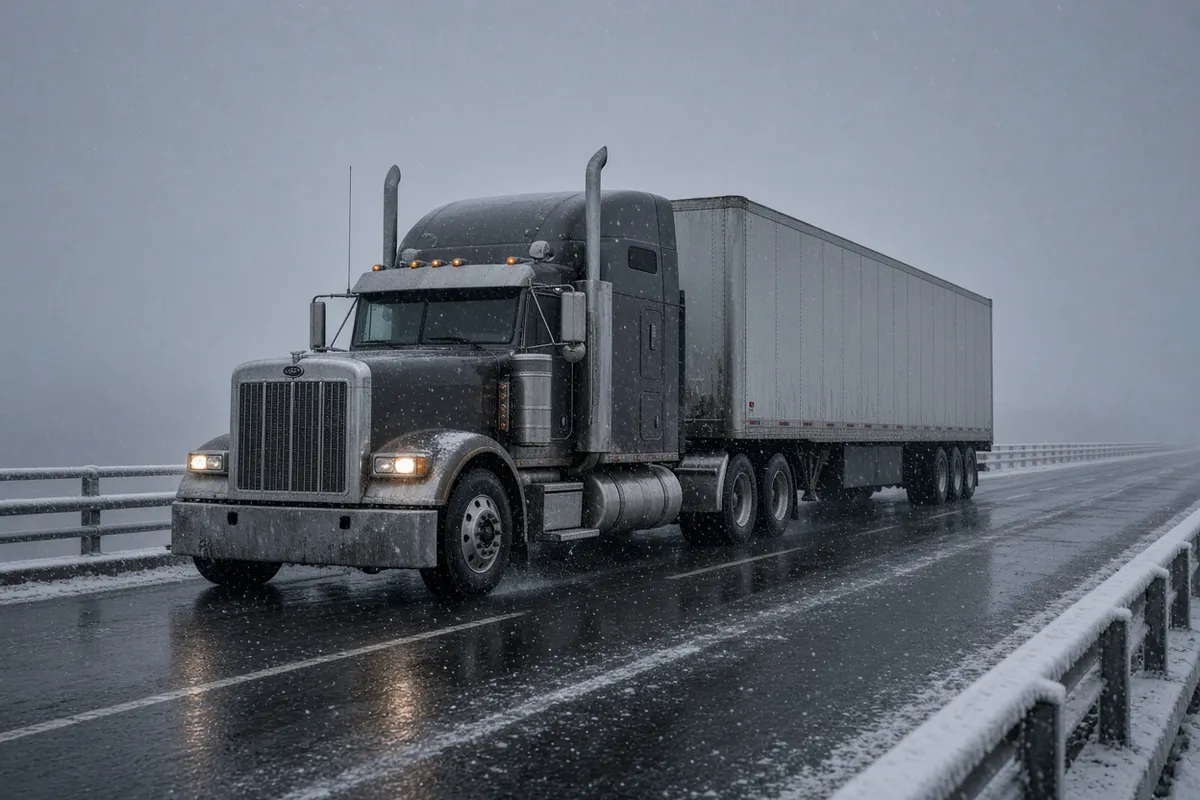
Most winter wrecks start the same way: a truck going too fast for the road, a sudden brake or steering input, and no room to fix it. The tips below come from the California DMV truck driver guide and the federal safety rules every CDL driver works under.
Before you leave
The California DMV says to inspect your truck each season, before winter weather hits. Pay extra attention to the things the cold finds first:
- tires and tread depth;
- wipers, washer fluid and defrosters;
- lights and reflectors, which get covered with road grime fast;
- air dryer and air tanks, so moisture does not freeze in the lines;
- chains, tensioners and gloves, if your route has chain laws.
Check the weather and the state 511 road reports for the whole route, not only the first leg. A dry morning start does not mean a dry pass in the afternoon.
How to spot black ice
Black ice is hard to see. It often looks like plain wet pavement. If it is below freezing and the road looks wet, treat it as ice.
The DMV guide gives a few signs to watch for:
- Bridges and overpasses. Check for ice there first. They freeze before the rest of the road.
- No spray from other vehicles. If the trucks ahead stop throwing water off their tires, the road has likely frozen.
- Ice on your mirrors and wiper blades. If ice is building up on your truck, it is probably building up on the road too.
- Melting ice. When the temperature rises to the point where ice starts to melt, the road gets even more slippery. Slow down more, not less.
Should you use the Jake brake on ice?
No. The DMV guide says not to use the engine brake or speed retarder on slippery roads, because it can make the drive wheels skid. On a tractor-trailer, a drive-wheel skid can turn into a jackknife.
The same guide also says not to brake harder than you need to and to make turns as gently as you can. Smooth is the rule: smooth on the throttle, smooth on the brakes, smooth on the wheel.
Grades in winter
On a dry downgrade, the DMV guide calls the engine’s braking effect your main way to hold speed, with the service brakes as backup. Pick a low gear before you start down. Do not try to downshift once speed has built up.
On ice or packed snow, the engine brake is off the table, so speed control starts before the grade. Get your speed down at the top, in the right gear, and keep it there. Use light, steady brake applications. Do not let speed build and then try to catch it.
Speed and space on slick roads
The DMV guide’s advice for slippery roads:
- Go slowly and look far ahead so you can keep a steady speed.
- Avoid slowing down and speeding up. Every change in speed is a chance to lose traction.
- Take curves slowly and do not brake in a curve.
- Do not pass slower vehicles unless you must.
- Do not drive alongside other vehicles.
- Keep a longer following distance, and when you see a jam ahead, slow down early.
- Give snowplows and salt and sand trucks plenty of room.
When should you stop driving?
Federal law is clear here. Under 49 CFR 392.14, a CMV driver must use extreme caution when snow, ice, sleet or fog cut visibility or traction, and must reduce speed. If conditions get dangerous enough, the driver must stop and not start again until the truck can be driven safely.
That rule is on you, not just your dispatcher. If the road is too bad, park in a safe place: a truck stop, a rest area or a parking area. Do not wait it out on a ramp or a shoulder, where other drivers may not see you in snow.
What about hours of service?
Bad weather can eat your clock. The adverse driving conditions rule lets you drive up to 2 extra hours to finish the run or reach a safe place, if conditions stop you from finishing within normal limits.
It only applies to weather or road conditions that you, or your carrier when dispatching you, did not know and could not reasonably have known about before the day started (49 CFR 395.2). A storm that was in the forecast when you left usually does not count. Note the reason in your log.
Quick checklist
- Check the forecast and 511 for the whole route.
- Inspect the truck, including wipers, lights and air system.
- Carry chains, warm clothes, food and water.
- Turn off the engine brake when the road is slick.
- Slow down before bridges, curves and grades.
- Leave extra room and avoid sudden moves.
- Park when it gets too dangerous, and log it.
Check the chain rules for your route in the truck chain laws guide, and see how to plan around I-80 closures in Wyoming (CDL News).
More road and weather news is in our Life on the Road section.