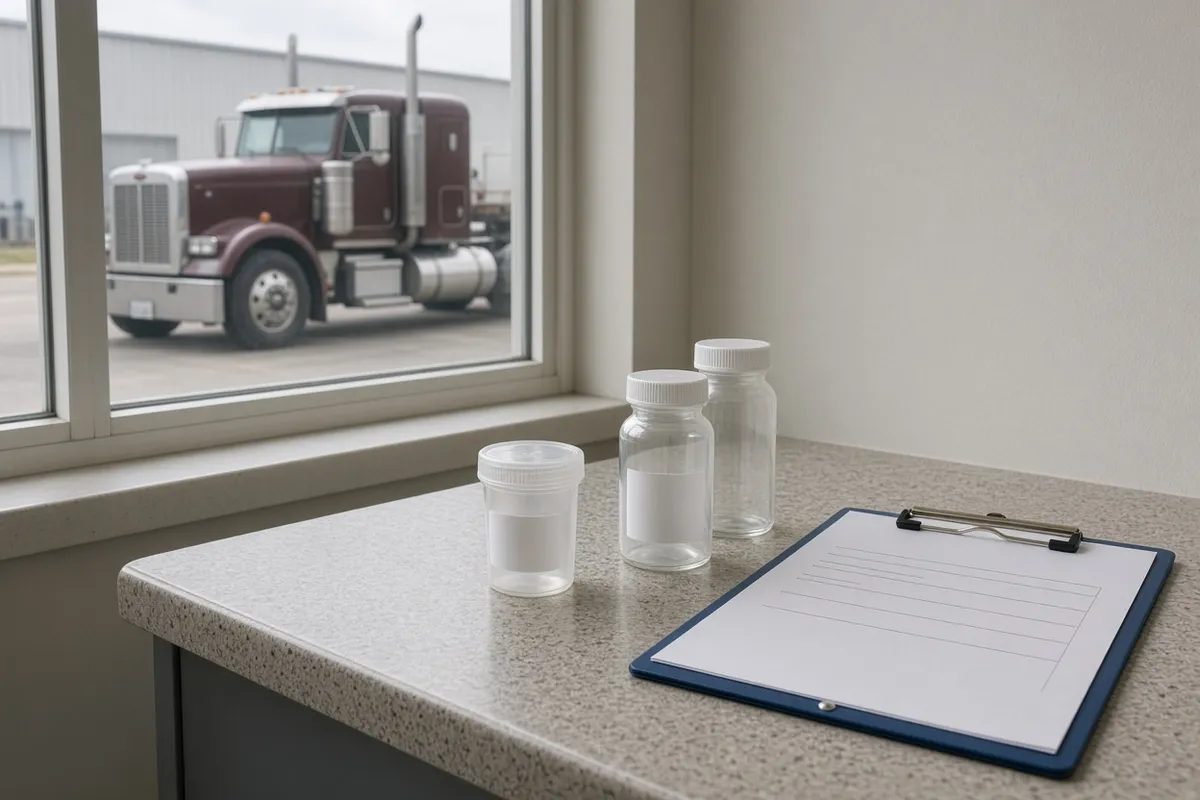
Every CDL driver who drives a commercial motor vehicle is covered by DOT drug testing. The test is the same at every carrier, because the procedures come from one rule, 49 CFR Part 40. Here is what the lab looks for and what happens to the result.
What drugs are on a DOT drug test?
DOT tests for five drug classes, sometimes called the “5-panel” test. The DOT Office of Drug and Alcohol Policy and Compliance lists them:
- Marijuana
- Cocaine
- Opioids: codeine, morphine, heroin, hydrocodone, hydromorphone, oxycodone, oxymorphone
- Amphetamines: amphetamine, methamphetamine, MDA and MDMA (ecstasy)
- Phencyclidine (PCP)
An employer cannot add other drugs to a DOT test. Part 40 says a DOT specimen must not be tested for additional drugs (49 CFR 40.13). A company can run its own separate tests under its own policy, but those are not DOT tests.
DOT drug test cutoff levels
The lab runs a screening test first. If the screen is at or above the cutoff, a second, more exact confirmation test follows. Cutoffs for urine, in nanograms per milliliter, from 49 CFR 40.85:
| Drug (what the lab measures) | Screening cutoff | Confirmation cutoff |
|---|---|---|
| Marijuana (THCA) | 50 | 15 |
| Cocaine (benzoylecgonine) | 150 | 100 |
| Amphetamine, methamphetamine | 500 | 250 |
| MDMA, MDA | 500 | 250 |
| Codeine, morphine | 2,000 | 2,000 |
| Hydrocodone, hydromorphone | 300 | 100 |
| Oxycodone, oxymorphone | 100 | 100 |
| Heroin marker (6-acetylmorphine) | 10 | 10 |
| PCP | 25 | 25 |
Is a DOT drug test urine or hair?
Only urine or oral fluid (saliva) can be used for a DOT drug test, according to ODAPC. Hair tests are not allowed under DOT rules. Instant-result cup tests are not allowed either: the specimen goes to a certified lab.
Some carriers also run hair tests. Those are company tests, separate from the DOT test.
Does a DOT drug test check for weed if it is legal in my state?
Yes. Marijuana is on every DOT drug test, in every state.
DOT’s medical marijuana notice says a state medical marijuana law is not a valid medical explanation for a positive test. The Medical Review Officer (MRO) will not change a marijuana positive to negative because a doctor recommended it.
CBD is not an excuse either. DOT’s CBD notice says DOT tests for marijuana, not CBD. But some CBD products contain more THC than the label says. If you test positive for marijuana, the MRO will verify it as positive even if you say you only used CBD.
What about prescription drugs?
A positive lab result does not go straight to your employer. First, an MRO, a doctor who reviews drug tests, will contact you. Under 49 CFR 40.137, a legally valid prescription can be a legitimate medical explanation. If it is, the MRO reports the test as negative. The MRO can give you up to five days to bring your records.
Marijuana can never be a legitimate medical explanation under the same rule.
ODAPC also says prescription and over-the-counter medicines are allowed if your doctor knows your job and decides the dose is safe for it. Tell your doctor you drive a truck.
How long do DOT drug test results take?
Part 40 sets deadlines for positive results. The MRO must tell your employer the same day the result is verified or the next business day, and send a written report within two days (49 CFR 40.167).
If your test is positive, you can ask for your split specimen (the “B” bottle) to be tested at another lab. You have 72 hours after the MRO tells you the verified result to ask (49 CFR 40.171).
When will I be tested?
FMCSA lists six types of DOT drug tests for CDL drivers:
- Pre-employment: you need a negative result before you drive.
- Random: unannounced, throughout the year.
- Post-accident: after certain crashes, such as one with a death.
- Reasonable suspicion: when a trained supervisor sees signs of drug use.
- Return-to-duty: after a violation, before you drive again.
- Follow-up: at least 6 observed tests in the first 12 months back.
What if I fail or refuse?
A positive test or a refusal takes you off the road right away. FMCSA says a refusal is generally equal to testing positive. Not showing up, leaving the site early or tampering with the sample all count as refusals.
To drive again, you must complete the return-to-duty process with a Substance Abuse Professional and pass a return-to-duty test. Since January 6, 2020, these violations are also reported to FMCSA’s Drug and Alcohol Clearinghouse, which every new employer checks.
Along with the drug test, you need a current DOT medical card to drive. If blood pressure is your worry at the physical, see our guide to DOT physical blood pressure rules.
A carrier may also send you for a company test. Here is the difference between DOT and non-DOT drug tests (CDL Weekly).
More rule news is in our Driver Rules section.