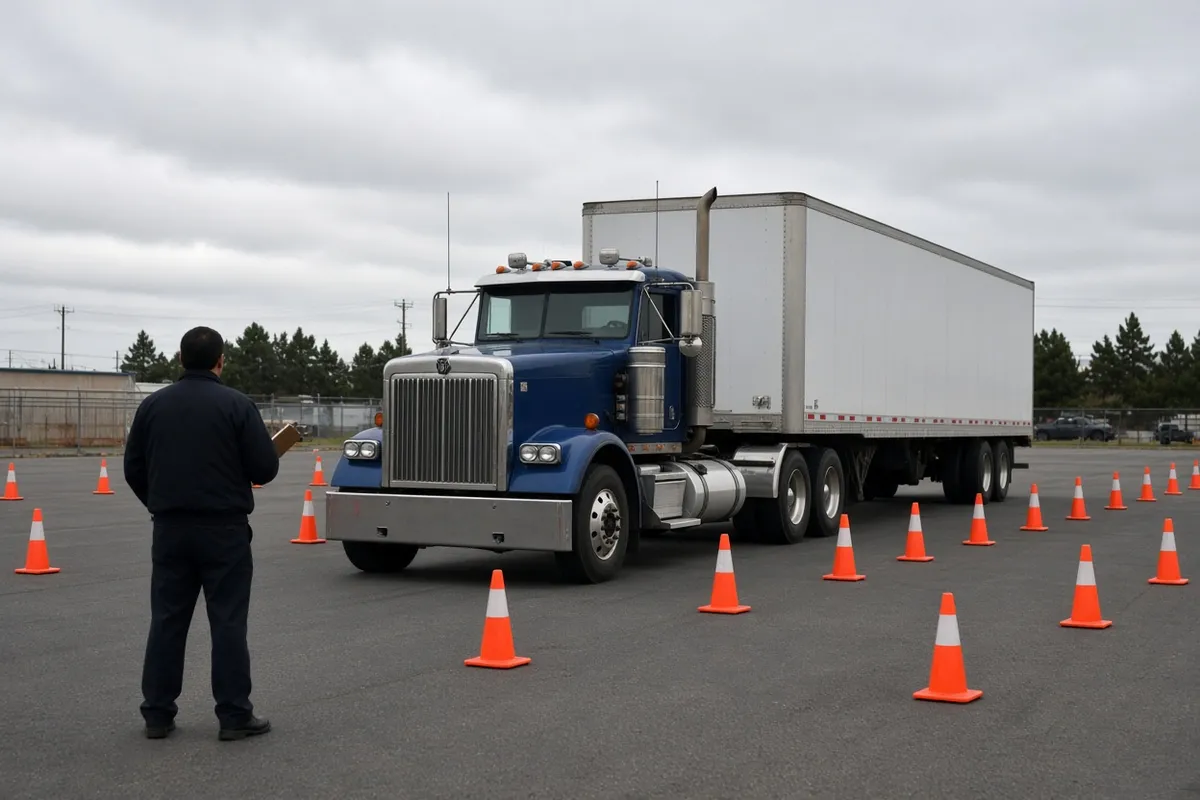
Since Feb. 7, 2022, you cannot just study the CDL manual, practice with a friend and take the test. Most new drivers must first finish entry-level driver training, or ELDT, at a school on FMCSA’s list. Here is who needs it, what it includes, what it costs and how to make sure your school counts.
What is ELDT?
ELDT is the federal minimum training for new commercial drivers. The rules are in 49 CFR Part 380, Subpart F. The training has two parts:
- Theory. Classroom or online lessons: basic truck operation, safe driving, inspections, hours of service, cargo, and more. The school gives a written test, and you need an overall score of at least 80% (49 CFR 380.715).
- Behind-the-wheel (BTW). Driving on a range and on public roads, with you in control of the truck. The instructor must check and document that you can do each skill. A simulator cannot be used for this part.
There are no minimum hours for either part (Appendix A to Part 380). The school must cover every topic in the curriculum and record how many hours you spent behind the wheel. If you need more time to show a skill, you get more time.
You must finish theory and BTW within one year of finishing the first part (except for hazmat) (49 CFR 380.603).
Who needs ELDT?
According to FMCSA, you need ELDT if you want to:
- get a Class A or Class B CDL for the first time;
- upgrade a Class B CDL to Class A;
- get a school bus (S), passenger (P) or hazmat (H) endorsement for the first time.
You do not need ELDT for a Class C CDL alone, or for the tanker (N) or doubles/triples (T) endorsements. Those are not on the list in 380.609. Here is how to get a tanker endorsement (CDL Weekly).
Who does not need ELDT?
The rule is not retroactive (380.603):
- If you got your Class A or B CDL, or your S, P or H endorsement, before Feb. 7, 2022, you do not need ELDT for it.
- If you got your CLP before Feb. 7, 2022 and get your CDL before that permit (or its renewal) expires, you do not need it either. A CLP issued on or after that date means ELDT applies.
Other exceptions in the same rule cover drivers who qualify for the military skills test waiver, drivers applying for certain restricted CDLs, drivers who are exempt from the CDL rules, and drivers who only want to remove a restriction from their CDL.
Can I take ELDT theory online?
Yes. The rules allow providers to offer theory only online, and state rules for classroom instructors do not apply to them (49 CFR 380.703). The online provider still must be on the Training Provider Registry, and the course must be prepared or delivered by a qualified theory instructor (49 CFR 380.707).
Behind-the-wheel training cannot be online. It needs a real truck and an instructor. A BTW instructor generally must hold a CDL of the same class or higher, with the right endorsements, and have at least 2 years of experience driving that kind of truck or teaching in it (49 CFR 380.605).
You can split the parts. Theory and BTW may come from different providers, as long as both are on the registry. But the range and public road parts of BTW must come from the same provider.
How to check that a school is on the registry
Only training from a provider listed on FMCSA’s Training Provider Registry (TPR) counts. When you finish, the school must report your training to the TPR by midnight of the second business day (49 CFR 380.717). The state checks that record before it lets you take the skills test, or for hazmat, the knowledge test (49 CFR 383.71).
Before you pay a deposit:
- Search for the school on the registry at tpr.fmcsa.dot.gov. Make sure the listing is for the same name and address, and covers the class you want (A, B, or the endorsement).
- Check that it offers the part you need. Some providers list theory only, some BTW only.
- Look at FMCSA’s proposed removal list. A school that got a notice of proposed removal is marked on the TPR site, and it must tell its current and future students (49 CFR 380.723).
- Check again before you start and before you finish. A listing can change.
- Get the TPR report confirmed. Ask the school to show you it has been submitted, so your test date is not held up.
This matters more now. On Dec. 1, 2025, FMCSA said it had removed nearly 3,000 training providers from the registry and put another 4,500 on notice. That was the first step in a review of the 16,000 listed providers. FMCSA listed reasons such as falsifying training data, not meeting curriculum or instructor rules, and not keeping records.
How much does ELDT cost?
There is no federal price. Here is what schools list on their own websites (checked Nov. 27, 2026):
| School | What you get | Listed cost |
|---|---|---|
| SUNY Broome, New York | Class A: classroom and behind-the-wheel training | $5,500 total |
| State Fair Community College, Missouri | Four-week CDL program | $5,210 tuition, plus $118 permit and licensing fees |
| Western Dakota Tech, South Dakota | Class A, 5 weeks: tuition, drug screening, materials, driving test | $4,800 |
| Gaston College, North Carolina | Class A: tuition, DOT physical, drug screen, CDL skills exam | $4,680, plus state permit and license fees |
| Western Dakota Tech, South Dakota | ELDT theory only, online | $150 |
Read what the price includes. Some schools add the DOT physical, drug test and skills test fee. Others do not.
Some students pay less. SUNY Broome, for example, says eligible students may get up to $2,500 toward tuition through the federal Workforce Innovation and Opportunity Act (WIOA), through the local workforce agency. Some carriers, such as Prime, run their own company-sponsored training. Read any training contract closely before you sign.
What it means for drivers
- If you are getting your first Class A or B, ELDT is part of the cost and the timeline. Plan for it.
- Don’t pay for a school until you have found it on the TPR yourself. Training from a provider that is not on the registry does not count.
- Before BTW, the school must check that you hold a CLP (380.707). To get a CLP for interstate driving, you first need a DOT physical.
- ELDT is the minimum. Ask how many hours you will actually drive.
How long it all takes, from physical to license: how long it takes to get a CDL (CDL News). Before you start, you will also face a pre-employment drug test. Here is what a DOT drug test checks for.
More CDL news is in our Getting Your CDL section.