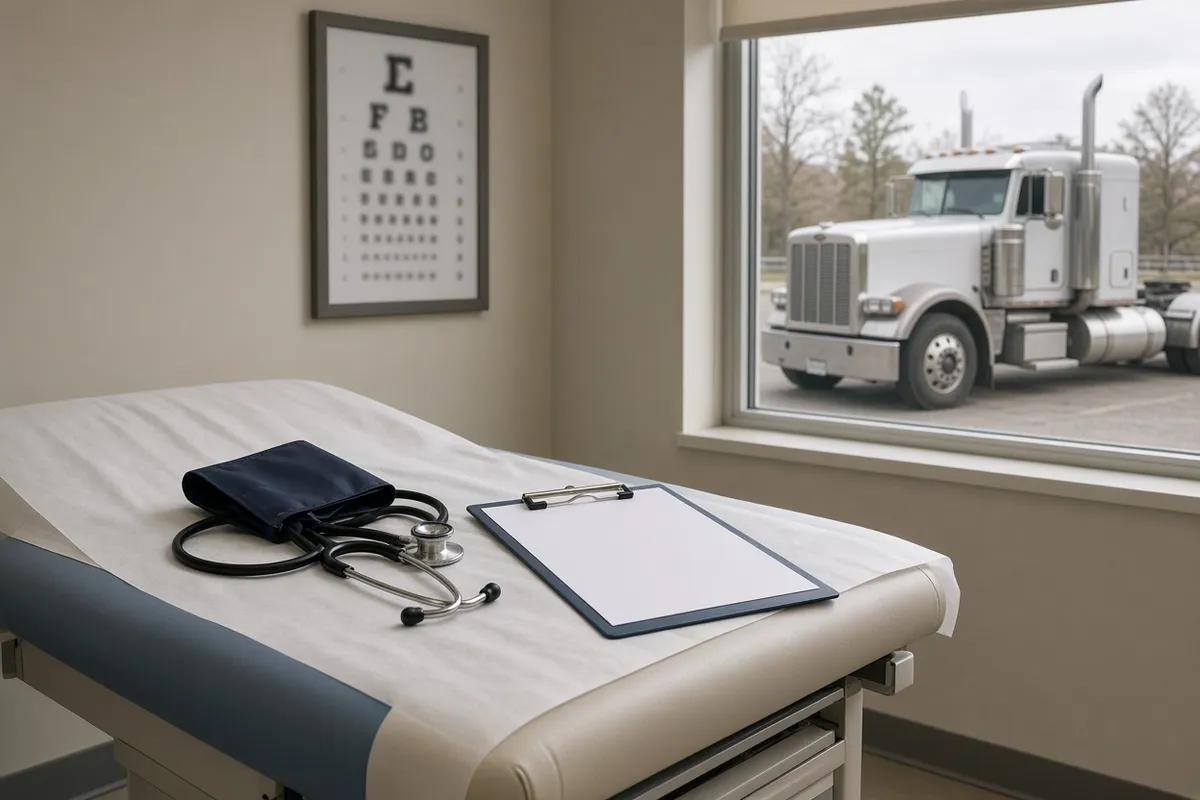
Every CDL driver who runs interstate needs a DOT physical, at least every two years. The price is not set by the government, so it changes from clinic to clinic. Here is what clinics charge, what happens at the exam and what to bring so you don’t have to come back.
How much is a DOT physical?
We checked the prices clinics post on their own websites. Here is what they listed on Nov. 27, 2026:
| Clinic | Where | DOT physical | DOT drug test |
|---|---|---|---|
| AFC Urgent Care North Austin | Austin, Texas | $90 flat rate, self-pay only | Not listed |
| First Care Medical Clinic | North and South Carolina | $90 self-pay | $90 extra |
| WorkOccMed | Clinic network | $110 | $80 extra (5-panel, MRO review included) |
| Nao Medical | New York City | $135 self-pay | Priced separately |
So at the clinics we checked, the exam alone cost $90 to $135. With a DOT drug test at the same visit, plan on roughly $170 to $180 at the two clinics that list both prices.
Before you book, ask three questions:
- Does the price include the medical card (the certificate)?
- Is the examiner on FMCSA’s National Registry? (They must be. See below.)
- If you need a drug test too, what does it cost?
Does insurance cover a DOT physical?
Often not. Many clinics sell the DOT physical as a self-pay service. AFC Urgent Care in North Austin, for example, says insurance is not accepted for it.
If you work for a carrier, ask before you go whether it pays for the exam, pays you back or wants you at a certain clinic. Keep the receipt either way. Owner-operators should ask their tax preparer if the exam counts as a business expense.
Does a DOT physical include a drug test?
No. FMCSA’s Medical Examiner’s Handbook says DOT drug and alcohol testing is not part of the physical exam. A carrier can have both done at the same visit, for example before hiring you, but they are separate tests with separate rules.
You will still give a urine sample at the physical. That is a urinalysis, a dipstick test that checks for specific gravity, protein, blood and sugar. It can point to problems like diabetes or kidney disease. It does not look for drugs.
The drug test is a different collection under DOT’s drug testing rules. Here is what a DOT drug test checks for.
What happens at a DOT physical?
First, you fill out the health history part of FMCSA’s Medical Examination Report form, MCSA-5875. It asks about past illnesses, surgeries, medicines and more. Answer honestly and completely. The examiner reviews it with you.
Then the examiner checks you. Key standards from 49 CFR 391.41:
- Vision: at least 20/40 in each eye, with or without glasses or contacts, a field of vision of at least 70 degrees in each eye, and the ability to tell red, green and amber signals apart.
- Hearing: you must hear a forced whisper at 5 feet or more in your better ear, with or without a hearing aid. A hearing test with a device can be used instead.
- Blood pressure: a key number at most exams. Here are the DOT physical blood pressure rules.
- Urinalysis and a physical exam of your heart, lungs, spine, limbs and more.
How long does a DOT physical take?
FMCSA does not set a length for the exam. Most of the time goes to the health history form and the checks listed above. You can save time by downloading form MCSA-5875 and filling out the driver section before you go. Ask the clinic how long to plan for, especially if you walk in.
If the examiner needs records from your doctor, for example for sleep apnea or a heart condition, you may not get the card that day. That can turn one visit into two, so bring those records with you.
What to bring to a DOT physical
- A photo ID or your driver’s license.
- A list of all medicines, with doses: prescriptions, over-the-counter drugs and supplements. The form asks for them.
- Your glasses or contacts and your hearing aid, if you use them.
- Records for any condition you are treated for, such as diabetes, heart problems, sleep apnea or seizures.
- Any FMCSA exemption or waiver letter you have, such as for vision or insulin-treated diabetes.
How long is a DOT medical card good for?
Up to 24 months (49 CFR 391.45). The examiner can give you a shorter card if a condition needs closer watch. High blood pressure and insulin-treated diabetes are common reasons.
The examiner must be listed on FMCSA’s National Registry of Certified Medical Examiners. A card from a doctor who is not on the registry does not count. After the exam, the examiner reports the results to FMCSA by midnight of the next calendar day (49 CFR 391.43).
What it means for drivers
- Shop around. The same exam cost $90 at one clinic and $135 at another in our check.
- Do not let your card run out. Book the exam a few weeks early. If you are already past the date, here is what to do when your medical card expires (CDL News).
- Getting your first CDL? The physical comes before your permit. Next comes entry-level driver training.
More rule news is in our Driver Rules section.