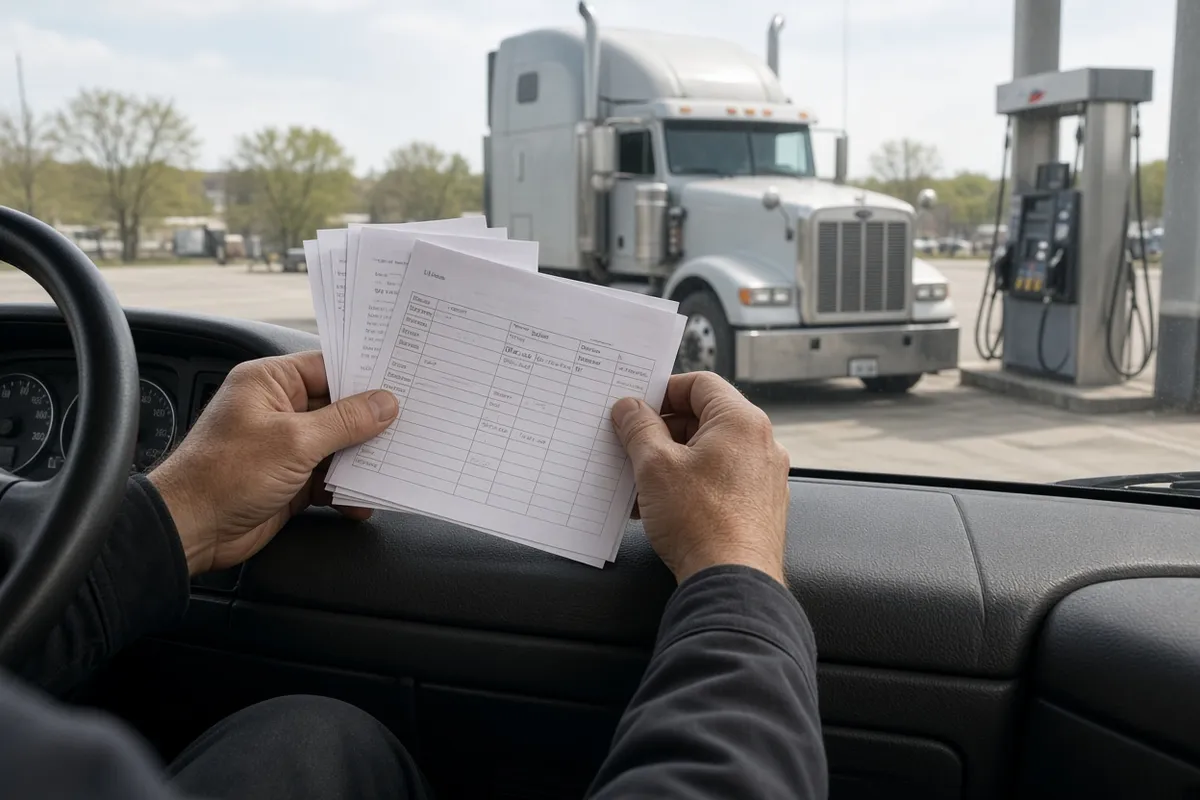
Every state and Canadian province charges its own tax on diesel. Without IFTA, a truck that runs in ten states would need ten fuel tax accounts. The International Fuel Tax Agreement replaces that with one license, one set of decals and one quarterly return, filed with your home state. IFTA, Inc. explains the basics on its carrier information page.
What is IFTA in trucking?
IFTA is an agreement among U.S. states and Canadian provinces. Your base jurisdiction processes your license application, sends your license and decals, and takes your quarterly return for all member jurisdictions.
Your base jurisdiction is the state where your qualified trucks are registered.
Who needs an IFTA license?
You need IFTA if you run a qualified motor vehicle in two or more member jurisdictions. Under the IFTA definition, that is a vehicle used to haul people or property that:
- has two axles and a gross vehicle weight or registered weight over 26,000 pounds (11,797 kg); or
- has three or more axles, at any weight; or
- runs as a combination over 26,000 pounds.
If you run in one state only and leave it now and then, you can buy fuel trip permits for those trips instead. The Texas Comptroller, for example, explains when trip permits can replace an IFTA license.
IFTA quarters and deadlines
Returns are due on the last day of the month after each quarter. When the due date falls on a weekend or legal holiday, it moves to the next business day, according to IFTA, Inc.
| Quarter | Months | Usual due date | Next due date |
|---|---|---|---|
| Q4 2026 | October–December | January 31 | Monday, February 1, 2027 (Jan. 31 is a Sunday) |
| Q1 2027 | January–March | April 30 | Friday, April 30, 2027 |
| Q2 2027 | April–June | July 31 | Monday, August 2, 2027 (July 31 is a Saturday) |
| Q3 2027 | July–September | October 31 | Monday, November 1, 2027 (Oct. 31 is a Sunday) |
Holiday rules can differ by state, so check the due date with your base jurisdiction.
File even if you did not run. IFTA, Inc. says a quarterly return is generally required even if the truck did not operate that quarter.
How the IFTA return works
The return compares the fuel you burned in each state with the fuel you bought there. The return works like this:
- Total miles. Add up all miles for the quarter, in every jurisdiction.
- Total gallons. Add up all fuel you bought for the truck.
- Average MPG. Divide total miles by total gallons. The Texas form uses total gallons purchased to calculate miles per gallon.
- Taxable gallons by state. For each state, divide your taxable miles there by your average MPG. That is how much fuel you are treated as burning there.
- Tax due or credit. Multiply taxable gallons by that state’s rate, then subtract the tax you already paid at the pump there (tax-paid gallons). You owe the difference, or get a credit.
Example: you drove 30,000 miles and bought 5,000 gallons, so your average is 6 MPG. If 6,000 of those miles were in one state, you are treated as burning 1,000 gallons there. If you bought only 600 tax-paid gallons in that state, you owe tax there on the other 400.
IFTA, Inc. publishes the tax rate tables for each quarter on its website. Use the table for the quarter you are filing.
What happens if you file late?
In Texas, for example, the penalty for a late or missing return, or for underpaying, is $50 or 10% of the delinquent tax, whichever is greater. Interest runs on unpaid tax for each month or part of a month after the due date. The Texas page lists the rate at 9% a year, or 0.75% a month.
Keep filing on time. Some base jurisdictions, including Texas, can refuse to renew your license if you missed returns or did not pay tax due.
IFTA decals and license
Your base jurisdiction sends two decals for each qualified truck. The Texas Comptroller says they go one on each exterior side of the cab. Put a copy of your IFTA license in every qualified truck.
Licenses and decals are renewed every year. Some states renew automatically and some need an application. IFTA, Inc. posts a renewal grace period memo each year, so check it before you run with old decals in January.
What records to keep
IFTA, Inc. tells carriers to keep records for at least four years from the due date or the filing date, whichever is later. Audits can stretch that. Keep:
- miles by jurisdiction, from odometer or GPS records;
- fuel receipts with the date, gallons, fuel type and seller;
- records of any bulk fuel you bought.
Without receipts, you cannot show the tax you already paid at the pump. Save each one the day you get it.
Two related costs for owner-operators: the yearly UCR registration and fee (CDL News) and why diesel prices are high (CDL Weekly).
More cost and paperwork news for owner-operators is in our Owner-Operator section.